

Earlier this month we released GDPx, a benchmark designed to measure the domains most valuable for frontier intelligence. Most agentic benchmarks only measure a single domain like coding or legal. The few that try to be comprehensive, like GDPVal or Agent’s Last Exam, make the mistake of selecting domains based on percentage of GDP or the O*NET taxonomy.
AI’s impact is nowhere near evenly distributed across the economy today, and we expect this trend to intensify in the future. Many tasks already can’t justify paying for Fable 5.2, much less Fable 7. Thus, if your goal is to track the progress of frontier models, you should focus on the domains where they will be most impactful.
It’s for this reason that GDPx intentionally forgoes industries like government and real estate, and instead covers the following domains:
Chip design
Cybersecurity
Biology
Finance
Legal
Quant trading
Recursive self-improvement (RSI)
Hardware design
Materials science
Alignment
Software engineering
Our methodology is also unique. To ensure all our tasks are truly representative of their respective domains, we partnered with 14 specialized data partners to make 206 tasks.
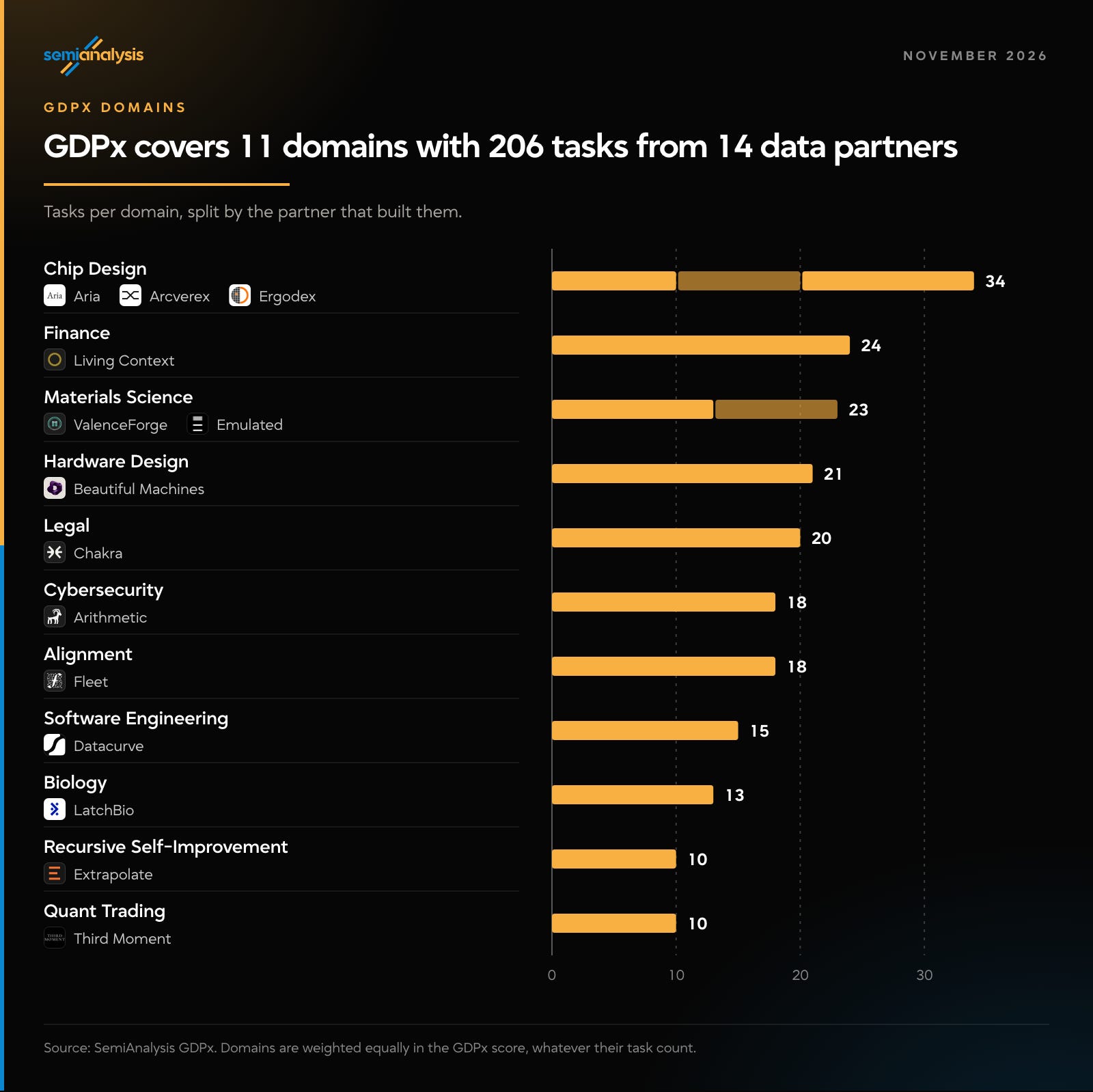
The single most notable thing about GDPx, however, is its difficulty. Whereas other benchmarks will often debut with the top model scoring over 50%, Opus 5.5—the highest-scoring model on release day—scored just 12% on GDPx. This massive headroom is what allows GDPx to discriminate between future model releases, unlike saturated benchmarks such as Terminal Bench 4.0.
Speaking of new model releases, it’s been a very busy month indeed.
SemiAnalysis is hiring for GDPx! If you’re interested in helping cement GDPx v2 as the world’s best benchmark, reach out to gdpx@semianalysis.com.
A flurry of new model releases
Since launching GDPx on November 1st, both Anthropic and OpenAI have released new frontier models. Google made a dramatic resurgence with the Gemini 4 series, and we’ve seen notable releases from Alibaba and Moonshot as well. The GDPx leaderboard now looks like this:
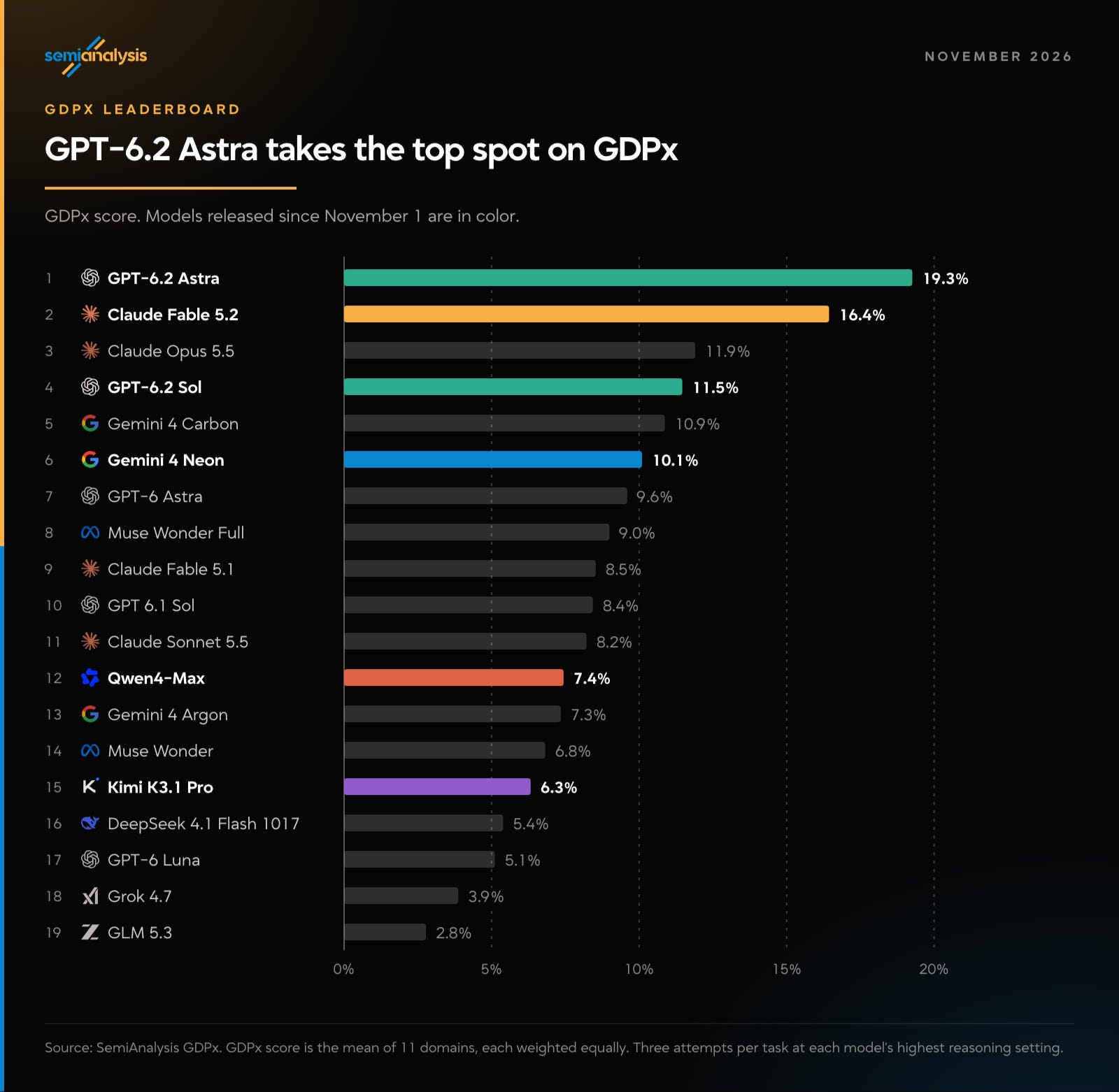
It’s worth emphasizing that certain models like Fable 5.2 and GPT-6.2 Astra have sandbagged overall scores due to their safety classifiers. If we exclude cyber, biology, and alignment, the three domains where safety classifiers sometimes kick in, and switch to partial grading to get more signal from the extremely difficult legal and finance domains (which default to binary grading), we get the following leaderboard instead.
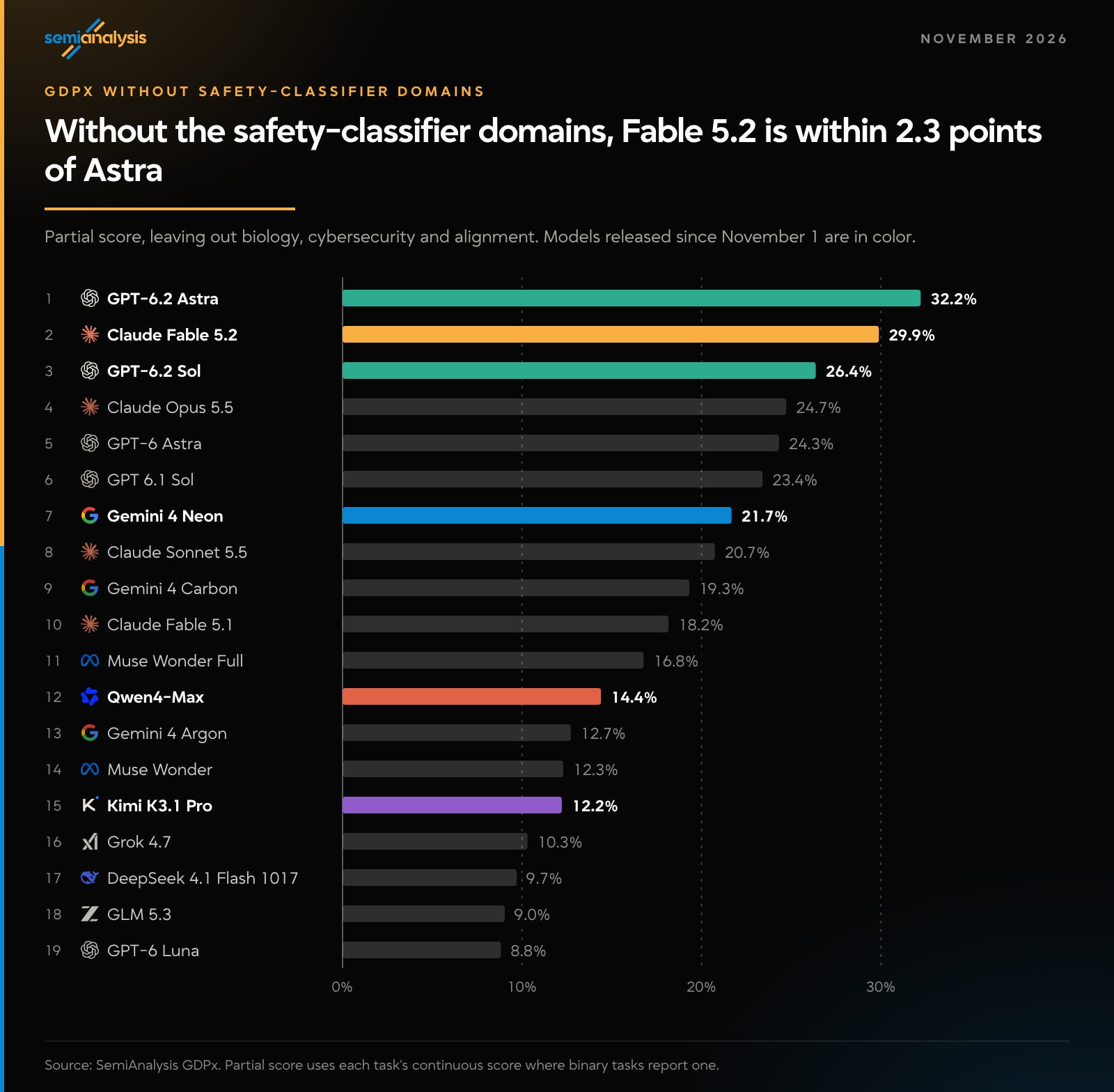
We think you can argue either of these is the “correct” GDPx leaderboard. On one hand, safety classifiers truly limit the usefulness of models in domains like cyber and bio. On the other hand, if the goal is to measure a model’s intelligence, penalizing it for refusing to attempt a task due to safety concerns feels quite unfair. As an aside, we did find that 6.2 Astra’s classifiers are weaker than 6 Astra’s, but the model itself will refuse to do tasks that 6 Astra’s classifiers previously blocked.
Either way, OpenAI is the current king of GDPx. Going off the main leaderboard, which covers all domains, 6.2 Astra ranks first with a score of 19.3%. Fable 5.2 ranks second at 16.4%, and the best non-OpenAI/Anthropic model, Gemini 4 Carbon, ranks fifth at 10.9%. Carbon just barely edges out the highly lauded Gemini 4 Neon, which ranks sixth with a score of 10.1%.
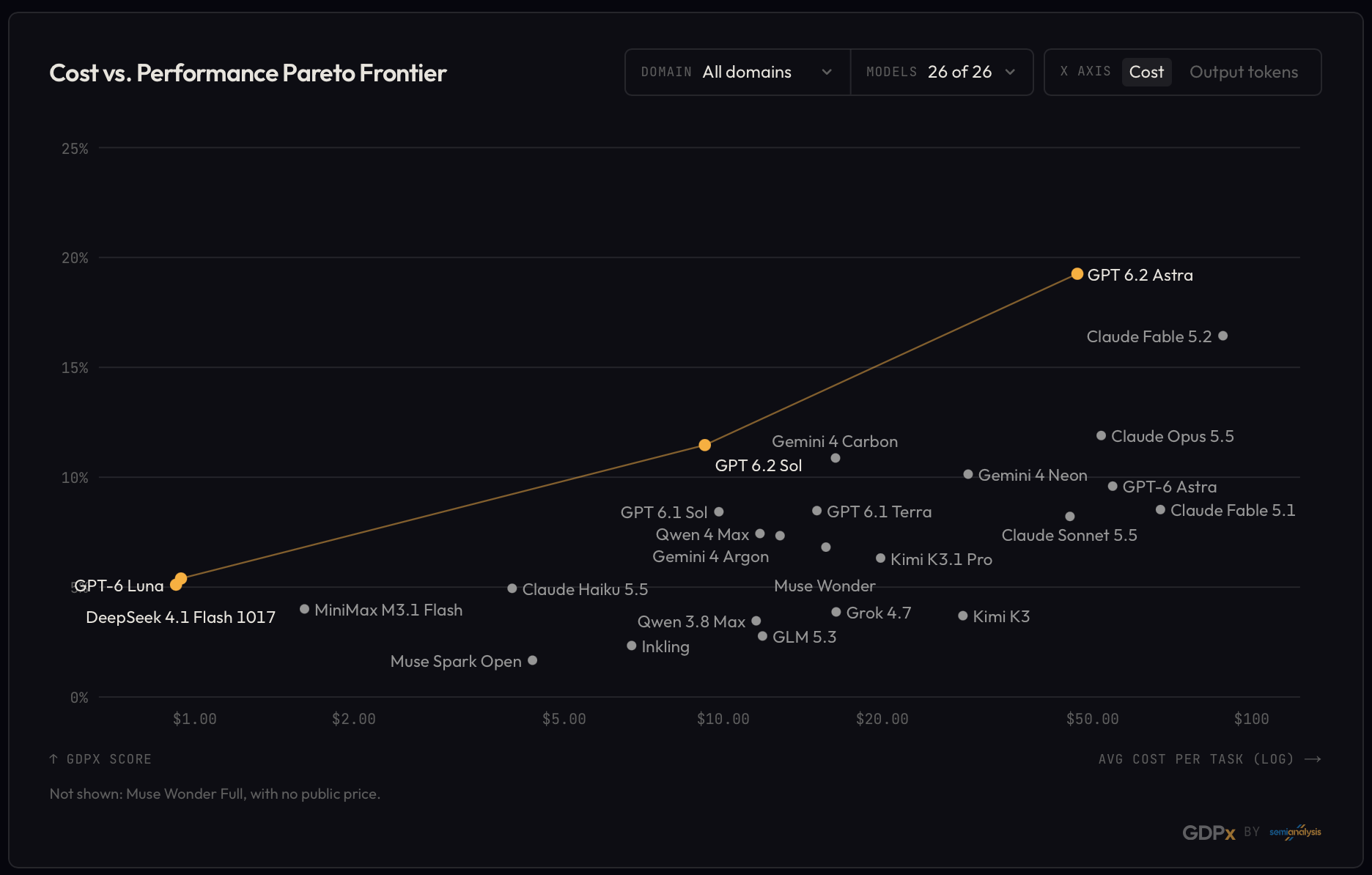
The cost-performance Pareto frontier is also entirely dominated by OpenAI. DeepSeek v4.1 Flash just barely sneaks in at the very low end.
Although the Twitter hive mind has recently been dumping on 6.2 Astra and praising Gemini 4 Neon, we believe GDPx accurately captures the true relative ranking of model capabilities in frontier domains. This will become clearer as we break down overall scores by domain in later sections, but Astra and Fable remain decisively above all other models in terms of raw intelligence. It’s just that most Twitter influencers simply aren’t working on hard enough problems today to truly push frontier models to their limits, which is why we believe Twitter vibes are more a reflection of how pleasant models are to work with, rather than raw model IQ. We agree that OpenAI’s newest round of models is extremely unpleasant to work with, much like that 1 autistic coworker who is just so cracked everyone deals with their bullshit. We attribute this to OpenAI RLing the model extremely hard and very far while having poor SFT data.
Gemini 4 Neon
Gemini 4 Neon is the model of the moment, with some declaring it the single best model in the world.
Earlier this year, we published a newsletter predicting the demise of Gemini/DeepMind. Clearly we were wrong. Compared to their competitors offerings at the time, Gemini 4 Neon is much better than Gemini 3.8 Flash was, and model progress at DeepMind has inflected up over the past few months. Neon is the best at Bio, but likely because OpenAI and Anthropic have more refusals.
With that being said, the GDPx results show Gemini is still decisively behind both Anthropic and OpenAI across virtually all frontier domains.
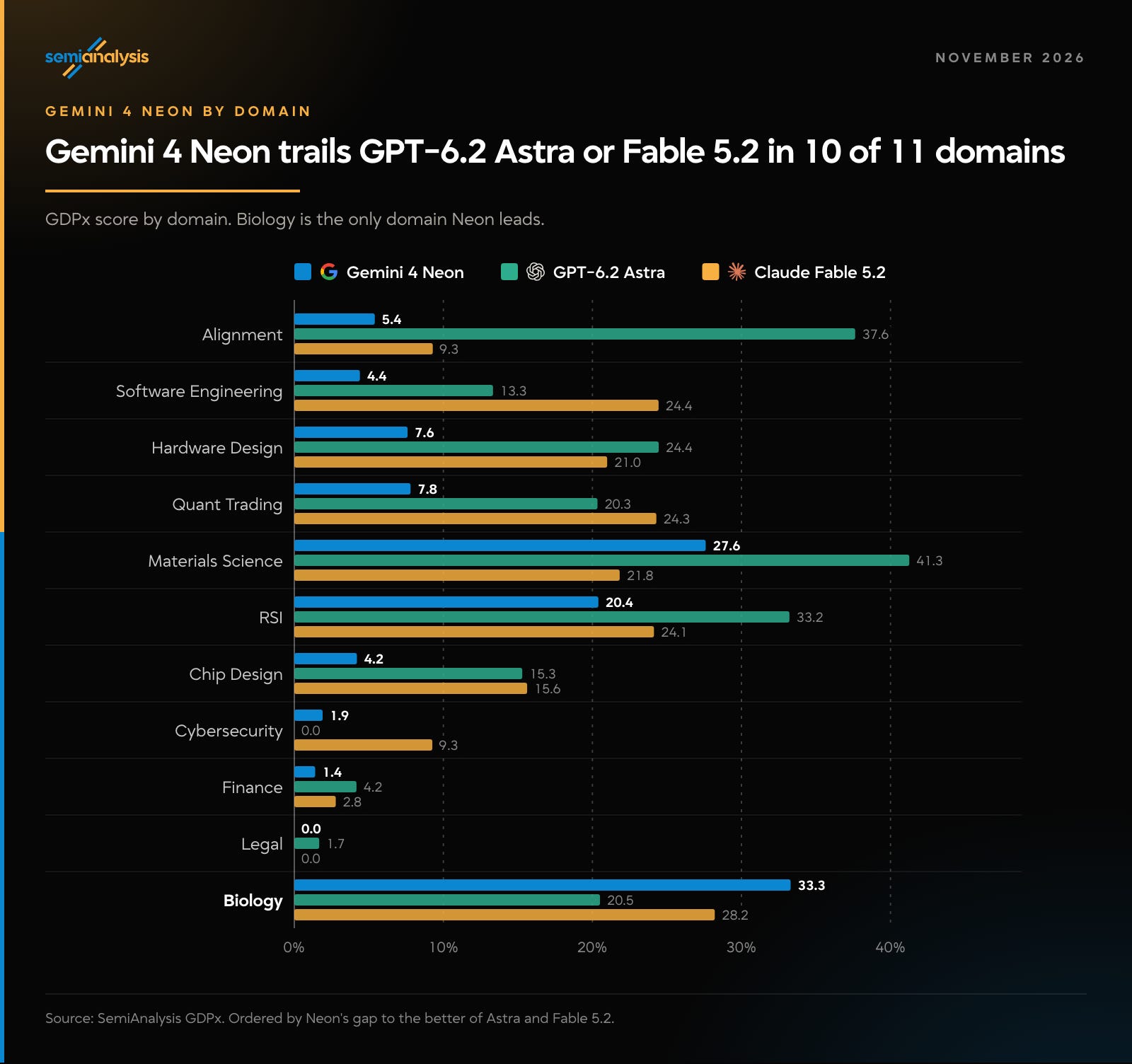
6.2 Astra significantly outperforms Gemini 4 Neon at RSI, materials science, and hardware design, while Fable 5.2 dominates in chip design, software engineering, and quant trading. Neon is the top-scoring model in biology, but this is likely due to more lenient safety classifiers (though we did find Neon to have stricter safety classifiers in cyber than other Google models).
We believe Gemini 4 Neon’s overwhelmingly positive reception is largely due to model behavior and not intelligence. Put simply, Neon is a pleasant model to talk to. Its liberal use of exclamation marks and cheerfulness reminds us of GPT 4o, which was a similarly adored model.
In terms of the overall AI race, we believe Anthropic and OpenAI are still clearly in a tier of their own. Google is a distant third, but also deserves its own tier. Meta, SpaceX, Moonshot, Alibaba, etc. are all fighting for 4th.
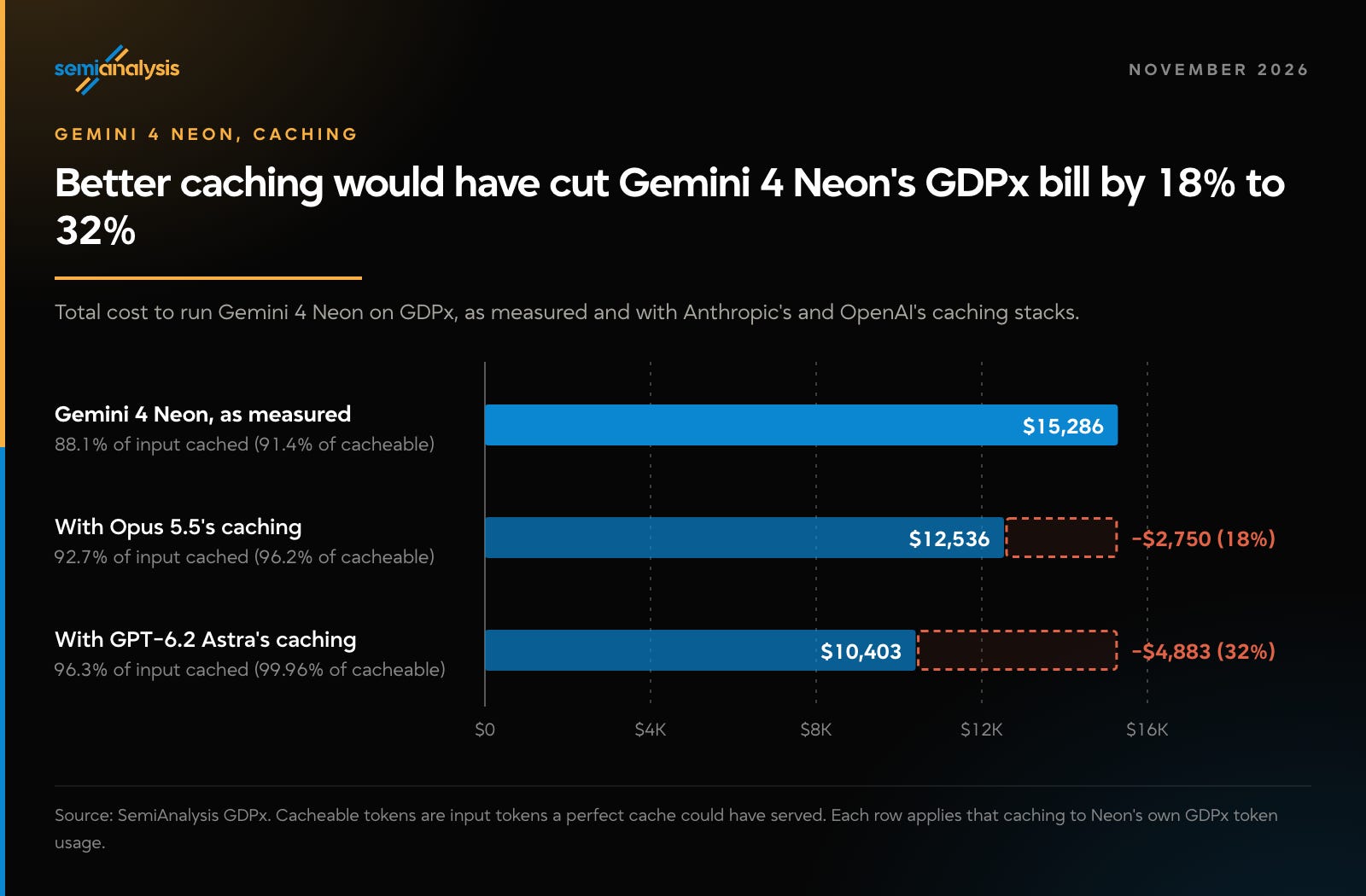
Lastly, as we previously explained to Tokenomics Model subscribers, it’s worth noting that Neon is unnecessarily expensive to run because Google’s prompt caching lags behind its competitors. Running Neon on GDPx cost us $15,286. Had Neon matched Opus 5.5’s cache hit rate, that bill would have been $12,536, about 18% less. At 6.2 Astra’s cache hit rate, it would have been $10,403, about 32% less. We compare theoretical cache hit rates here, meaning the share of cacheable input tokens that were actually served from cache, since that isolates the quality of each provider’s caching stack from how a particular workload is structured.
To its credit, Google shipped a caching update just today (another 4.5% increase to Neon’s cache hit rate, which would cut this bill by roughly 17-18%), so some of this gap may already be closing. Improving an inference serving stack is also something models are rapidly becoming superhuman at, so we expect this gap to continue closing in the near future.
GPT-6.2 Astra and Sol
GPT-6.2 Astra and 6.2 Sol both do extremely well on GDPx, scoring 19.3% and 11.5%, respectively. Interestingly, this goes against most people’s subjective impressions of the models. Public reception to 6.2 Astra on X was embarrassingly bad, with one influencer calling it the “worst model OpenAI has ever released.”
However, 6.2 Astra also represents a significant drop in base model log-perplexity, which OpenAI recently disclosed as one of the best proxies for measuring models pretraining intelligence, and therefore sample efficiency. How do you explain this apparent contradiction?
Taking a closer look at individual GDPx domains reveals the answer. GPT-6.2 Astra excels on tasks that require complex reasoning like chip design, hardware design, materials science, and RSI. It’s also the first model to score higher than 0% on legal, and it is SOTA on finance.
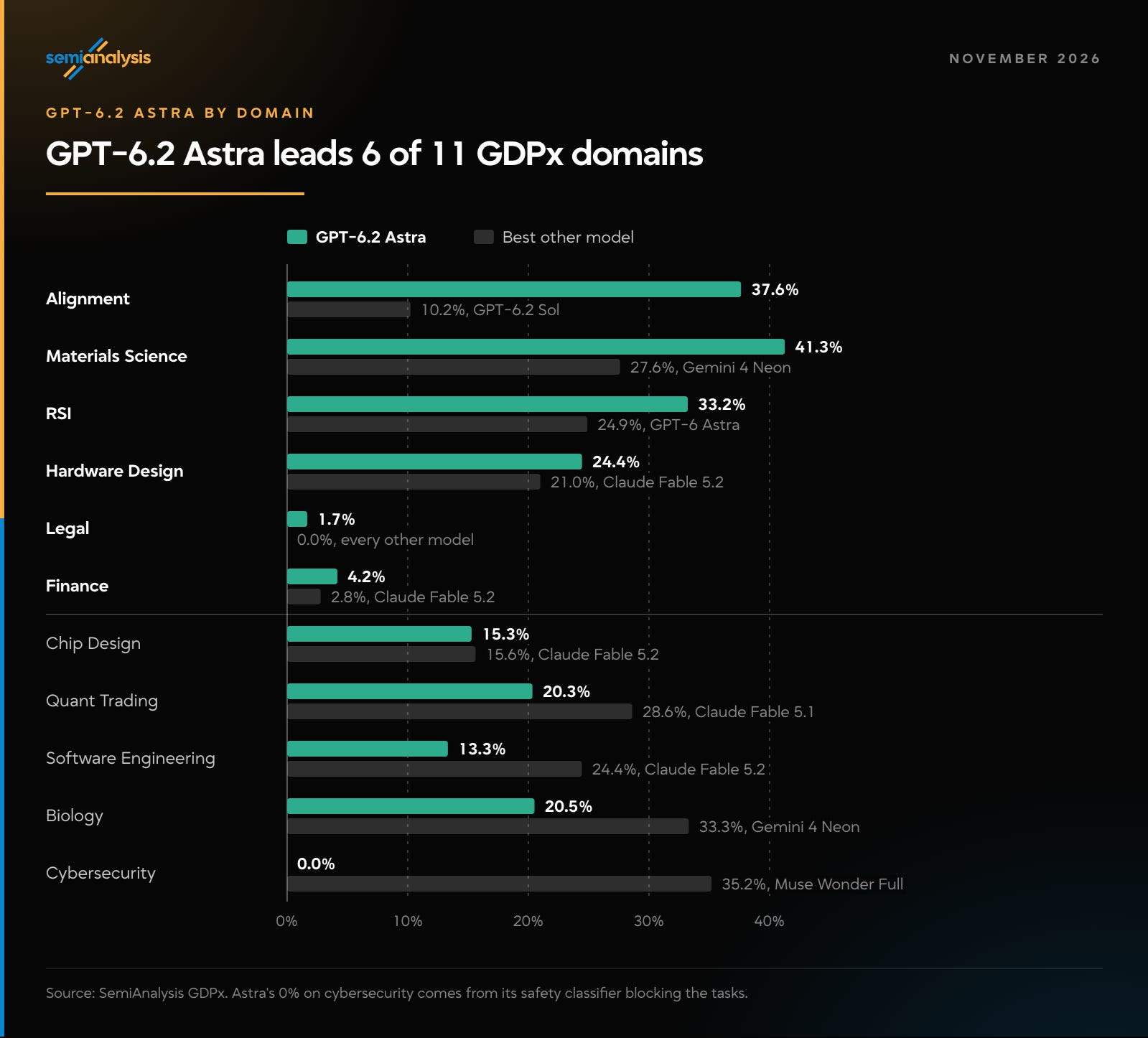
Notably, 6.2 Astra is lackluster at software engineering, which is the domain most people on X evaluate models on. It scores half that of Fable 5.2. Qualitatively, the model is also often too literal when following instructions, fails to infer user intent/make reasonable assumptions, and is just generally annoying to talk to. Most users aren’t working on science problems hard enough for 6.2 Astra to flex its genius, so it’s no wonder why public sentiment was generally poor.
Interestingly, we did observe some examples of 6.2 Astra having a very good understanding of industry norms for particular domains. As an example, it knows that before adding an acquisition to a buyout model, you check whether anything the company has signed since the model was built changes the numbers. On one of our M&A tasks, it searched the data room for every document dated after the model it was given and found a signed letter that changes a payment the company already owes. That was the first correct answer any model has produced on that task.
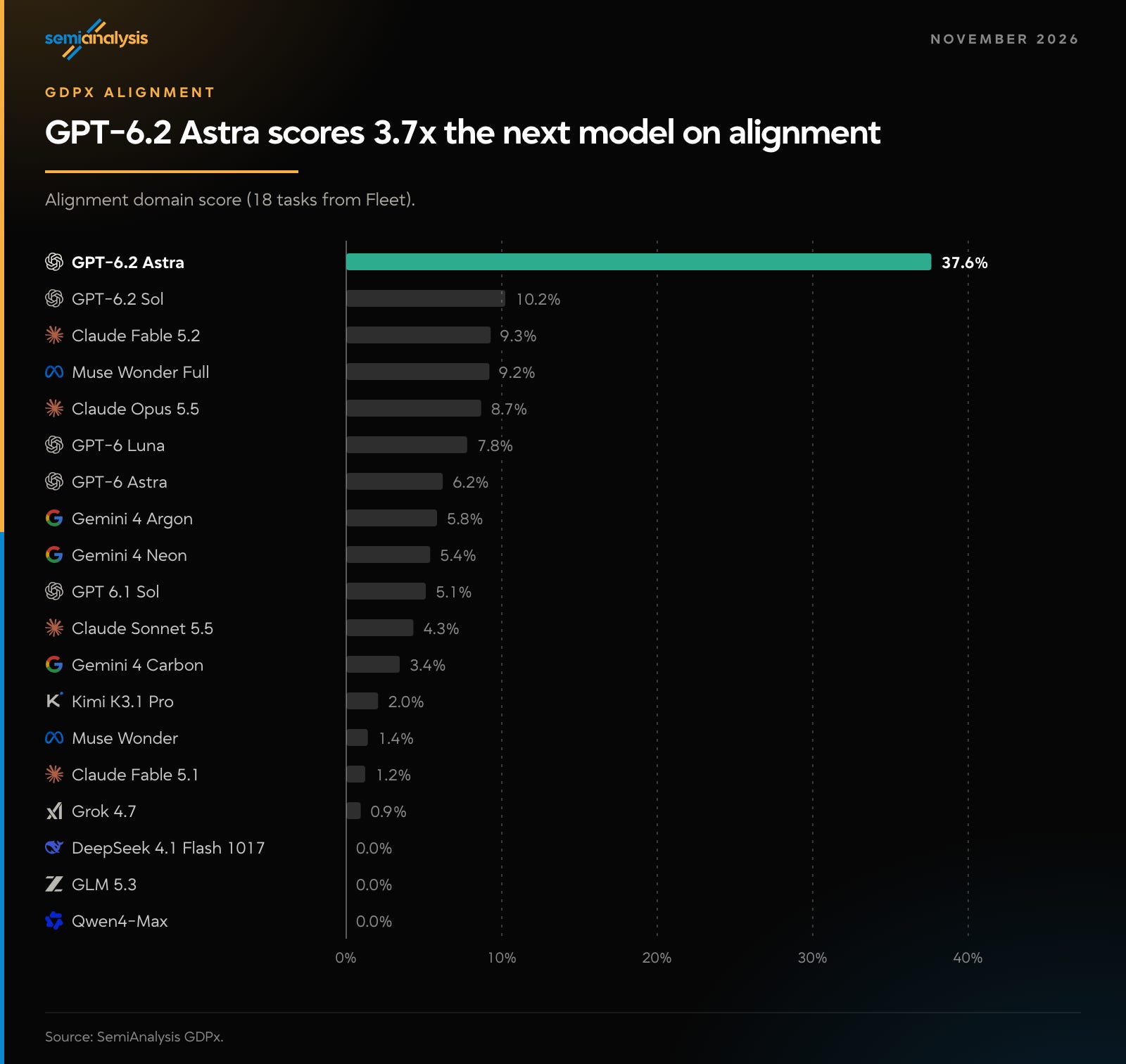
It’s also worth emphasizing that 6.2 Astra scores extremely high on alignment. It appears that OpenAI’s safety commitments post Hugging Face weren’t just for show, and it’s reassuring to see such rapid progress here.
6.2 Sol is similarly spiky to 6.2 Astra and worse at everything except quant and SWE. Overall, we believe the current negative sentiment around OpenAI’s models is overblown. The 6.2 series is clearly extremely smart, and OpenAI completely dominates the cost-performance pareto frontier as well—they just need to do a better job making their models pleasant to work with.
Fable 5.2
Fable 5.2 is the second-best model on GDPx at 16.4%, behind only 6.2 Astra, and the gap narrows once safety classifiers are taken out (29.9% vs 32.2% with partial grading). It’s also by far the most expensive model to run. At $88 and 1.23M output tokens per task, Fable 5.2 costs 1.9x as much as 6.2 Astra and uses 3.9x as many output tokens, for a lower score.
Much of this comes from Fable 5.2’s increased persistence and its proclivity for spawning subagents for testing and review. For now, all GDPx runs are done at the highest possible reasoning level.
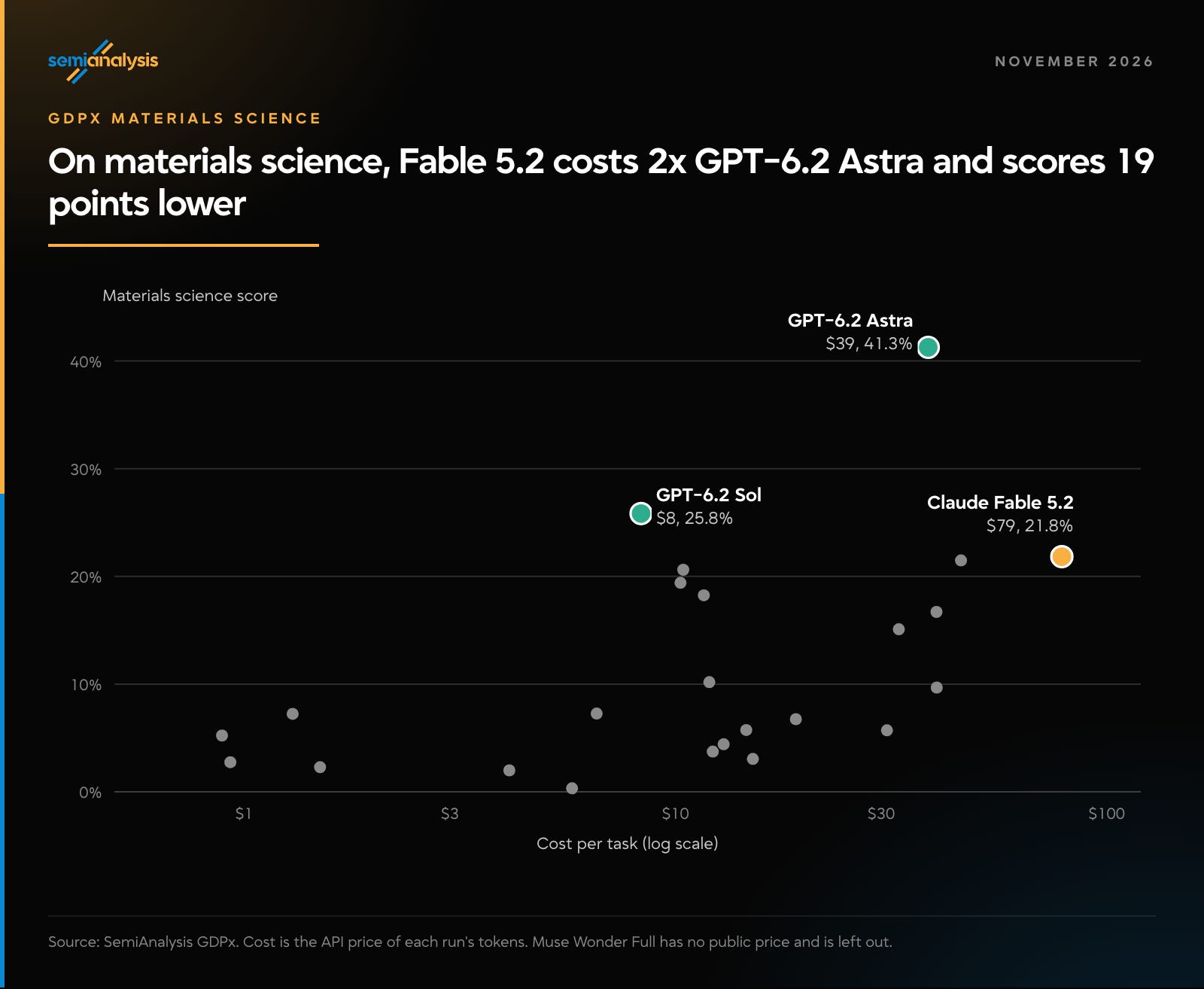
Materials science is the starkest example. Fable 5.2 costs 2x as much as 6.2 Astra per task and uses 3.7x as many output tokens, yet scores 19 points lower (21.8% vs 41.3%). Even 6.2 Sol beats it (25.8%) at roughly a tenth of the cost ($8 vs $79 per task).
Finance tells a similar story. With partial grading, Fable 5.2 scores 53.6%, effectively tied with Opus 5.5 (54.6%) and 6.2 Astra (53.5%). But it uses 2.3x as many output tokens as Opus 5.5 and 12x as many as 6.2 Astra, which makes it 6.6x as expensive as 6.2 Astra per task.
Software engineering is where Fable 5.2 shines. At 24.4%, it nearly triples Opus 5.5 (8.9%) and is well ahead of the next best model, 6.2 Sol (15.6%). Even here the extra capability isn’t free: compared with Opus 5.5, its cost per task rises by about the same multiple as its score (2.8x), and it costs 17x as much as 6.2 Sol.
It’s also interesting to note that 6.2 Astra does significantly better than Fable 5.2 at RSI (33.22% vs 24.13%). However, we think this is largely due to Anthropic explicitly nerfing their public models’ AI research abilities.
Qwen4-Max and Kimi K3.1 Pro
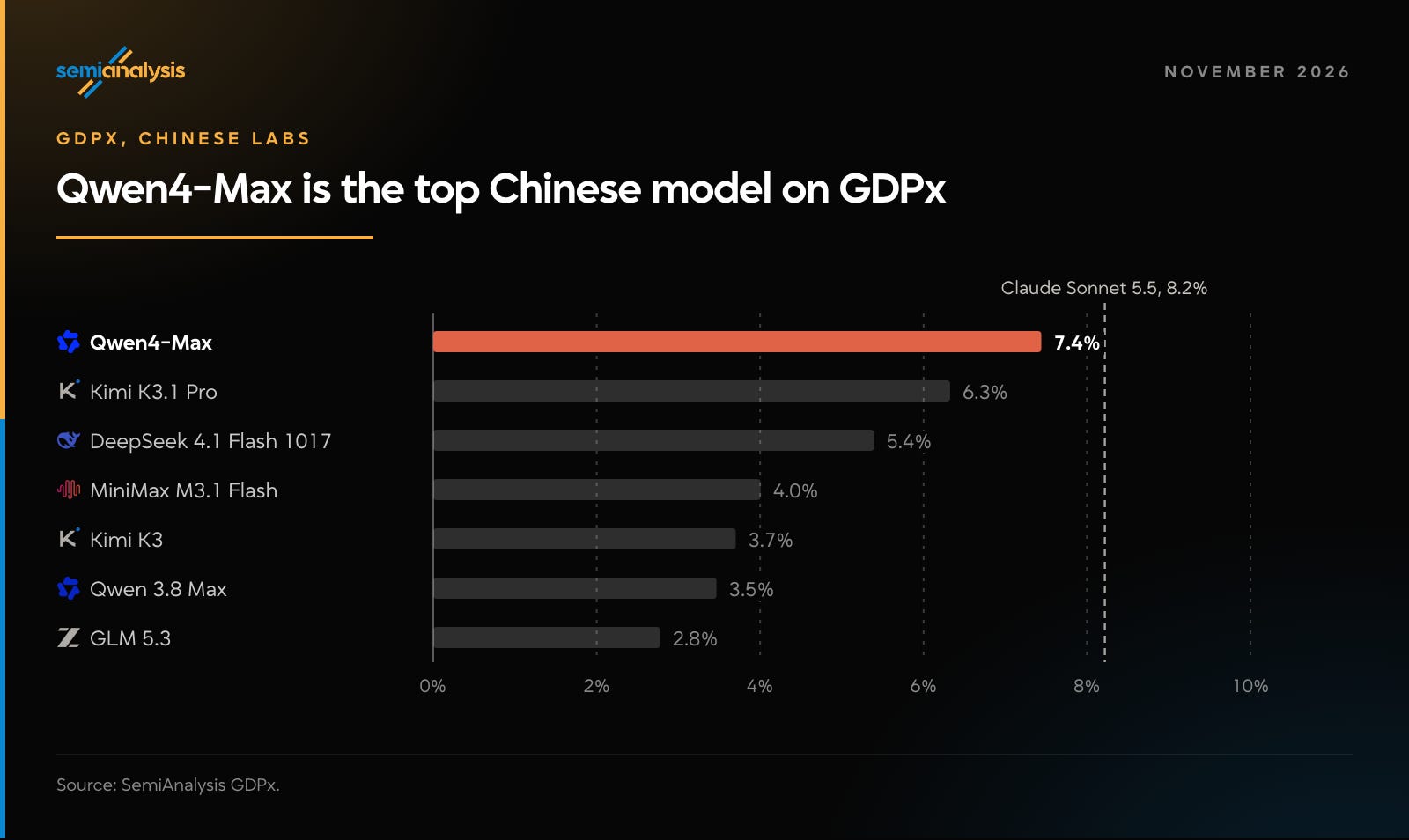
Qwen4-Max is the highest scoring Chinese model on GDPx at 7.44%. It’s a little worse than Claude Sonnet 5.5, though significantly cheaper. Qwen4’s biggest gains vs Qwen3.8 are in software engineering, RSI, cyber, and bio.
Kimi K3.1 Pro performs comparatively worse on GDPx than other benchmarks like the Artificial Analysis Intelligence Index, but this is largely because K3.1 Pro is benchmaxxed on Terminal Bench 4.1 (which is 10% of the AA index). K3.1 is unironically the number one model on Terminal Bench, when in reality, the model clearly still lags Fable 5.2, Gemini 4 Neon, 6.2 Astra, etc on agentic coding.
We believe GDPx provides the most accurate relative ranking of model quality and continue to be pleasantly surprised how well the benchmark matches our subjective opinions.
We’d also like to thank Modal for being our inference provider for Kimi K3.1 Pro.
Custom cyber post-trains
As part of this update, we also evaluated a number of custom cyber models. It’s clear that domain specific models are becoming significantly more relevant as Anthropic, OpenAI, and Google continue to crackdown on their safety classifiers. Speaking from firsthand experience, it is extremely non-trivial to get unmitigated cyber/bio access from any of these providers. We believe this is a good thing for the safety of the world, but it also means that from here on out, the majority of users will be better off using models from different providers for these select domains.
Furthermore, Anthropic is also explicitly nerfing capabilities like RSI, and there are other domains like materials science where having proprietary data can enable non-frontier labs to train state of the art models. We plan to continue evaluating many more domain-specific models on GDPx in the future.
We tested 3 custom models on GDPx cyber
A cyber post-train of DeepSeek v4.1 Flash from Hinoki called HO1
Abliterated versions of Kimi K3.1 Pro and DeepSeek v4.1 Flash from Boundless
Surprisingly, the 2 abliteratred models performed slightly worse than their vanilla open source counterparts, while Hinoki HO1 performed marginally better.
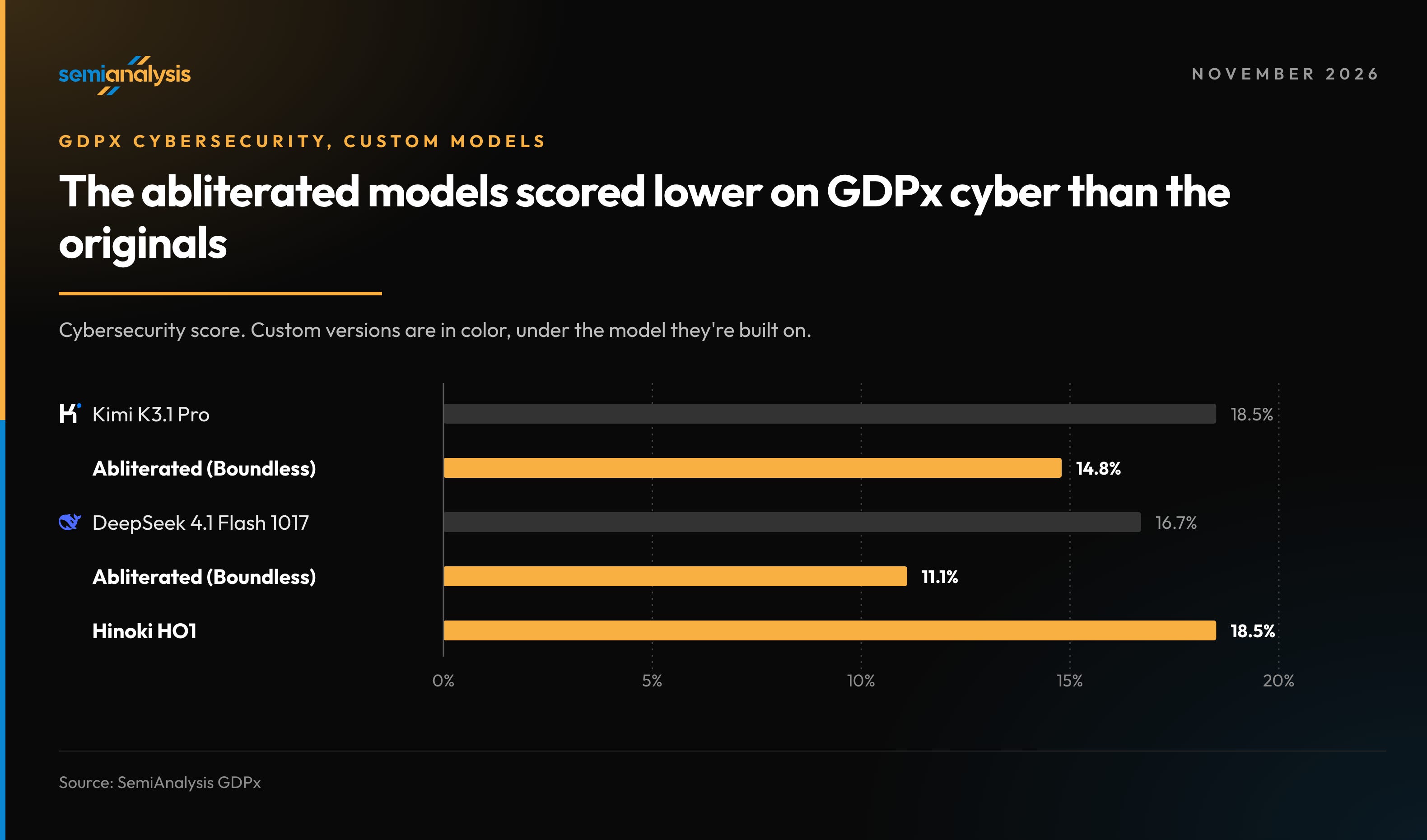
We think this is largely because the vanilla OSS models never refused any of our cyber tasks to begin with and we’re still in the early days of training domain specific models. It will be interesting to see whether custom models can demonstrate stronger GDPx performance in the near future with additional post-training.